
 The bee’s knees is an expression for something excellent or the highest quality. YOU want to have knees of the highest quality…the bee’s knees.
The knee is a well-crafted hinge joint held together with muscles, tendons and ligaments. Given proper care and barring traumatic injury it can last its owner a lifetime.
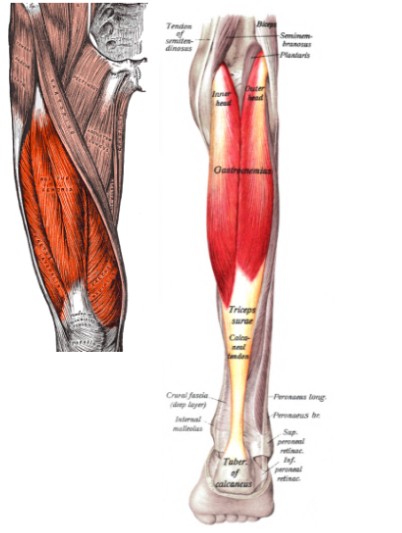
The knee is controlled, for the most part, by the quadriceps in the front of the upper leg and the gastrocnemius in the back of the lower leg. The lower leg and feet propel you up the stairs, the quadriceps are used to come down. And if you are a mountain climber or serious hiker you KNOW what your quadriceps can feel like at the end of your day.
The proper care of knees should start at birth with passive bending and stretching exercises done for a minute or so daily for your little not yet walking one. Next, knees that can walk, should walk and not be cooped up in carriages, playpens and car seats which will systematically starve the will to move. Muscles don’t atrophy from non-use: it’s worse than that: they never develop in the first place.
Running is great but stay off the road and use the beach, grass, and trails for your running pleasure. Running on the road abuses knees. You would NEVER run a good horse on the road. It would ruin their legs. Are yours not worth the care?

Poor training abuses knees and overloading in weight training abuses knees…to mention a few. Nothing wrong with weighttraining but use common sense, listen to your body and don’t be swayed by the trainer with an ego when your body, common sense and gut tell you ENOUGH. Knees should be put through full range of motion. That includes deep knee bends. There was a time when youngsters were not allowed to do deep knee bends. It seems that a study was done using five football players and weight lifters who were asked to do “duck walks” and then complained that their knees hurt. The conclusion of the study was that duck walks and knee bends were bad. The net result of that totally mistaken paper was that children in elementary schools were told that knee bends were dangerous.
TEST FOR HEALTHY QUADRICEPS AND GASTROCNEMIUS
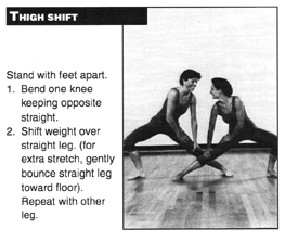
Help protect your knees by keeping your quadriceps and gastrocnemius flexible. The easiest way to test the quadriceps is to lie face down, bend your knee and have someone press your ankle toward your back pocket. Your heel should touch your back pocket area or gluteals. If your heel doesn’t touch, measure the distance from your heel to your gluteals. Try THIGH SHIFTS to help your quadriceps.
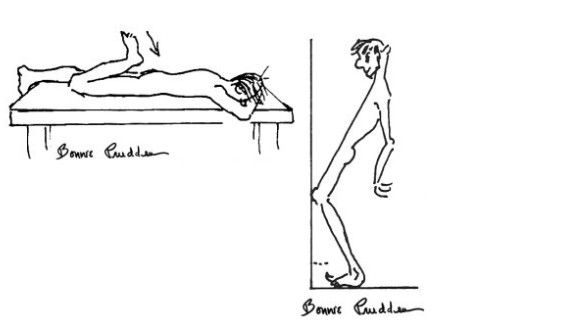
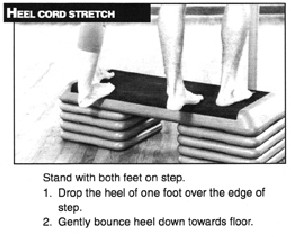
To test the gastrocnemius, calf muscles, stand barefoot facing a wall with one foot about two inches in front of the wall. Bend the knee and keep your foot flat on the floor. Does your knee touch the wall? If so, move it back a bit and retest. Enter the distance from your toes to the wall at the last point where you can successfully bend and touch the wall with your knee while the heel stays flat. Test the other leg. The legs are tested separately. The average is 4 inches but notch skiers and skaters who require great ankle flexibility to maintain balance can measure up to 7 inches. Try Heel Cord Stretch to help your ankle flexibility.
YOUR BEE’S KNEES WILL THANK YOU AND TAKE YOU WHERE YOU WANT TO GO.
If you have questions or need help, email me at enid@bonnieprudden.com. For more information about Bonnie Prudden®, Bonnie Prudden Myotherapy®, books, self-help tools, educational videos, NCBTMB Approved Courses, videos free, for rent or for purchase, blogs, vlogs and newsletters, visit www.bonnieprudden.com or call 520-299-8064 if you have questions or need help. Enid Whittaker, Managing Director, Bonnie Prudden Myotherapy®